
by Chris Kutalik
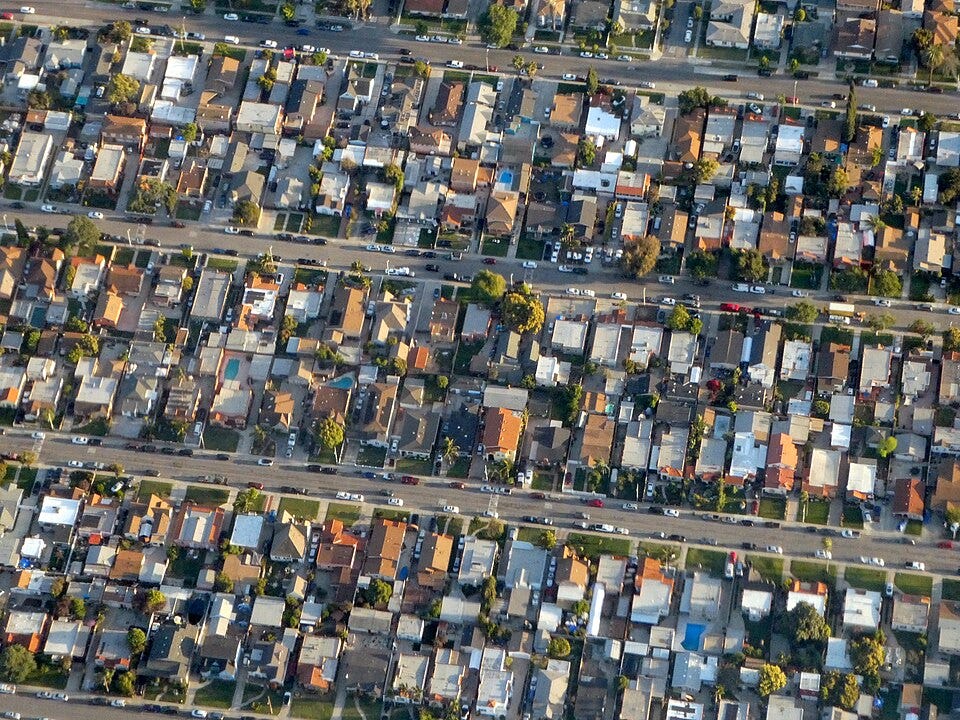
Los Angeles, the city I live in, is caught in a seeming paradox. The metro area is one of the wealthiest urban regions in the world, yet hundreds of thousands of working class Angelenos live without stable housing and millions more pay unsustainable rents—way beyond the standard 30 percent of income recommended.
Every serious projection shows the housing crisis only deepening even with small-scale pro-housing reform and the market-oriented solutions of YIMBYs.
For decades, leaders have tried incremental fixes: zoning tweaks, density bonuses, and tax incentives for private developers. None of these have matched the scale of the problem. If Los Angeles is serious about becoming livable for working people, it needs something massive and public.
The answer may be simple if incredibly ambitious and beyond the current political will: Los Angeles needs to build housing like we once built freeways. If Los Angeles had the will to build over 625 miles of freeway from the end of WW2 to now, it can surely lay down apartments.
A Public Builder?
Imagine a publicly owned development firm explicitly chartered to acquire land, finance, design, build, and manage housing across the affordability spectrum. Let’s call it LA Housing Works.
This would flip the script. Instead of subsidizing private developers and hoping affordability trickles down, the city would compete directly with them. Profits from market-rate units could be reinvested into public housing. Affordable apartments would be built and kept affordable not just for 10 or 20 years, but for generations.
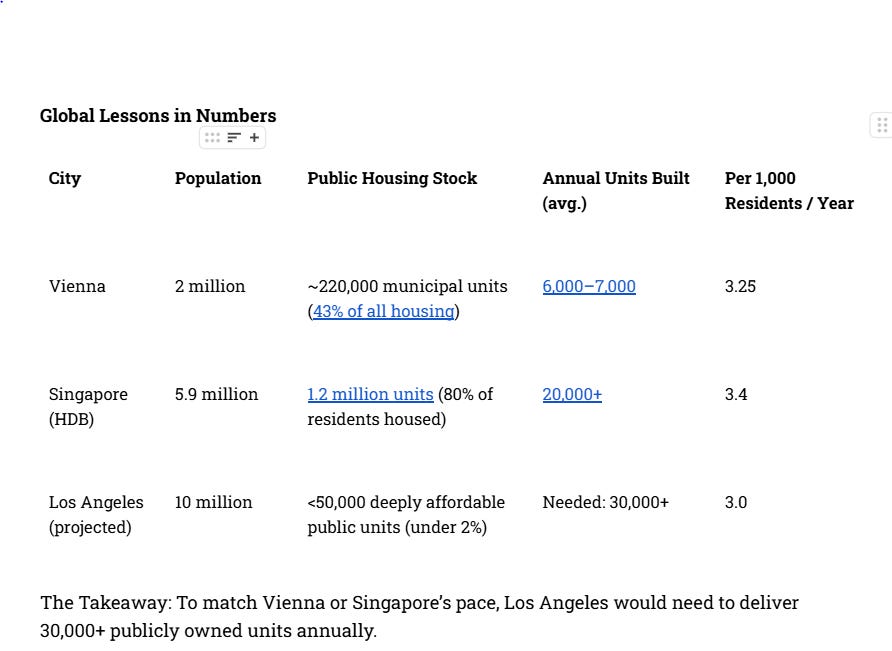
Vienna’s public housing system, the Gemeindebau, works on this principle. Singapore’s Housing and Development Board (HDB) does too. Both show that when cities build, they can outcompete speculation and guarantee housing as a right.
Housing Works should have by-right authority (the ability to build higher density, multifamily units) to build housing at scale, with streamlined approval timelines. This isn’t just about public housing—it’s about changing the rules of the game. Right now, LA depends on failing private actors to deliver housing, dangling subsidies and hoping affordability follows.
But what if the city itself set the benchmark?
By producing high-quality, lower-cost apartments—courtyard complexes, towers, and row houses—the municipal builder could force private developers to compete. Tenants could choose public housing not as a last resort, but because it’s better.
Financing the Moonshot — ULA and Beyond
Measure ULA—the “mansion tax” on properties above $5 million—was projected to generate $600M–$1.1B annually. In practice, it’s brought in $480M total through 2024—about $288M/year on average due to a slow luxury market (Credaily).
Even at that lower level, ULA is LA’s largest single affordable housing fund (Oxy.edu report). Combined with state housing bonds, federal support, and reinvested profits from a municipal builder, it could finance a massive new build program.
Even the most ambitious construction campaign will take years to bear fruit. Without tenant protections, people will be displaced faster than we can build. That means political struggles to expand the Rent Stabilization Ordinance (RSO) and protect the ULA from being cut by the CA state assembly.
Planning for Ten Million
New York City houses nearly ten million people in just 300 square miles. LA County already has ten million people, but sprawled across 4,700 square miles.
The question is not whether Los Angeles can fit more people—it already has them. The question is whether we will house them affordably and sustainably, or condemn them to overcrowding, car dependency, and sprawl.
Planning for ten million Angelenos means embracing density as part of LA’s heritage. From Wilshire’s Art Deco towers to Westlake’s garden apartments, this city once built boldly. We can again.
A New Deal for Housing
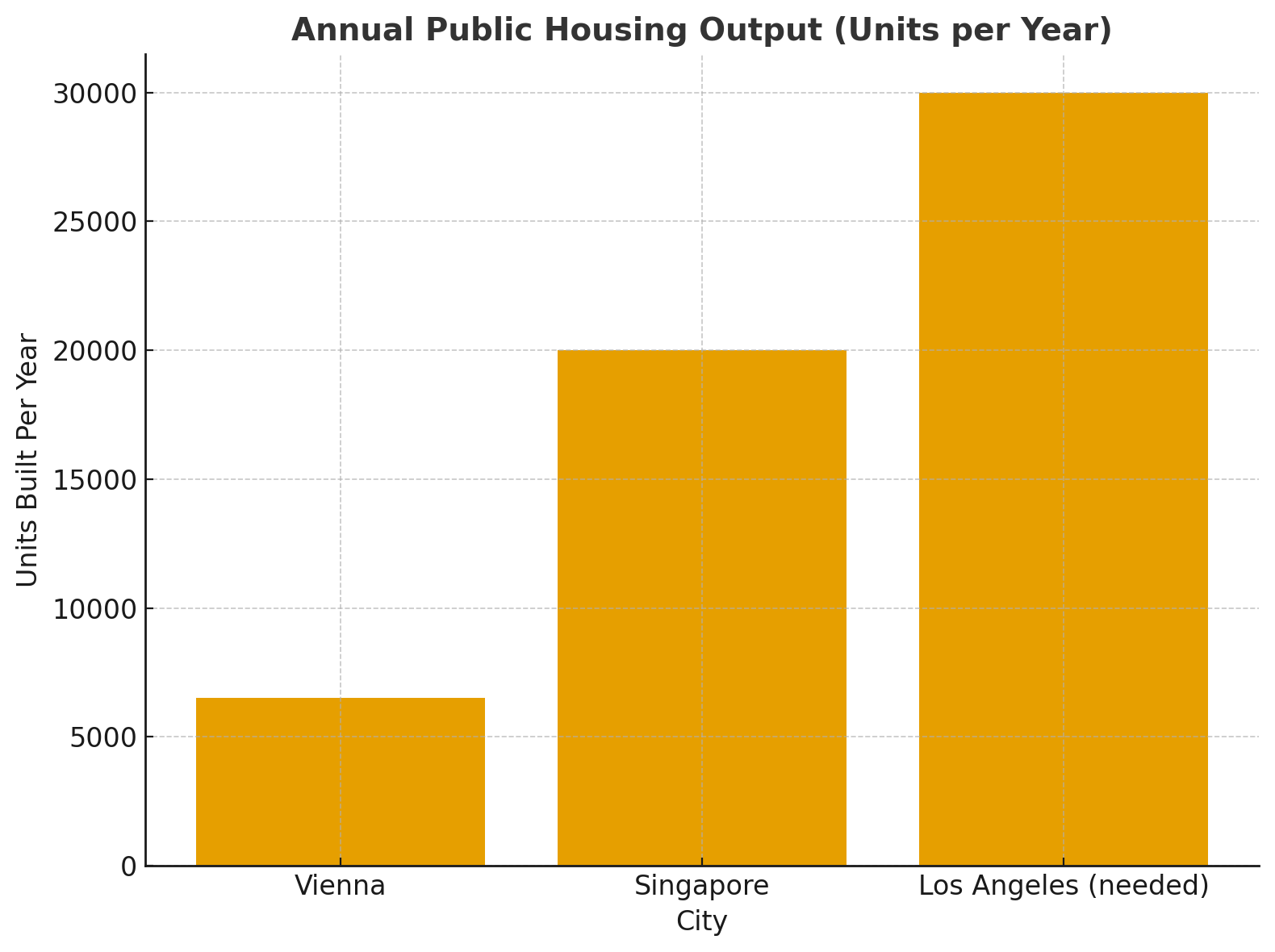
Vienna built 64,000 subsidized homes in 15 years. Singapore continues to produce 20,000+ annually. Los Angeles has the land, money, and need. What it lacks is the political will.
A public builder, streamlined approvals, strong tenant protections, and a financing plan tied to ULA and other mechanisms could create a self-sustaining cycle of mass housing production.
The lesson is clear: housing must become public infrastructure, not just private commodity.
Politically we are still a long, long way off from the balance of forces to win this kind of solution. We would need short- and medium-term victories—changing municipal and state laws, building political majorities with the will, and addressing logistical barriers. Recruiting a workforce, overcoming labor shortages, and ensuring quality construction are not small tasks. Some of these hurdles—like the need for skilled labor—could be a plus if tied to large jobs guarantee programs.
And there are of course other number of ways to use transformative ways rooted in struggle to win from policy like the Green New Deal for Public Housing to fights born out of things to come.
But if we can imagine Los Angeles as a city of ten million, we can imagine and work toward a horizon of a public works project to match. The only question is whether we’ll choose to outbuild the crisis—or be buried beneath it.